If you hire a lawyer on contingency, the fee percentage alone does not tell you what you will get. I’d boil the whole issue down to this: you need to know the fee rate, when it changes, whether costs come out before or after the fee, whether you owe costs if you lose, and what liens or funding paybacks may reduce your check.
Here’s the short version:
- I see contingency fees commonly range from 33.33% to 40%
- That rate may increase after a lawsuit is filed or if the case goes to trial
- Case costs like filing fees, depositions, and experts are often separate
- A single contract term can change a client’s payout by $86,500+ on a $1,000,000 result
- Medical liens, unpaid bills, and lawsuit funding can cut the final amount even more
- U.S. rules generally require a written fee agreement and a written closing statement
A few numbers make the point fast. On a $1,000,000 verdict with $50,000 in costs, a 40% fee on the gross leaves the client with $550,000. A 33% fee after costs leaves $636,500. Same case. Very different result.
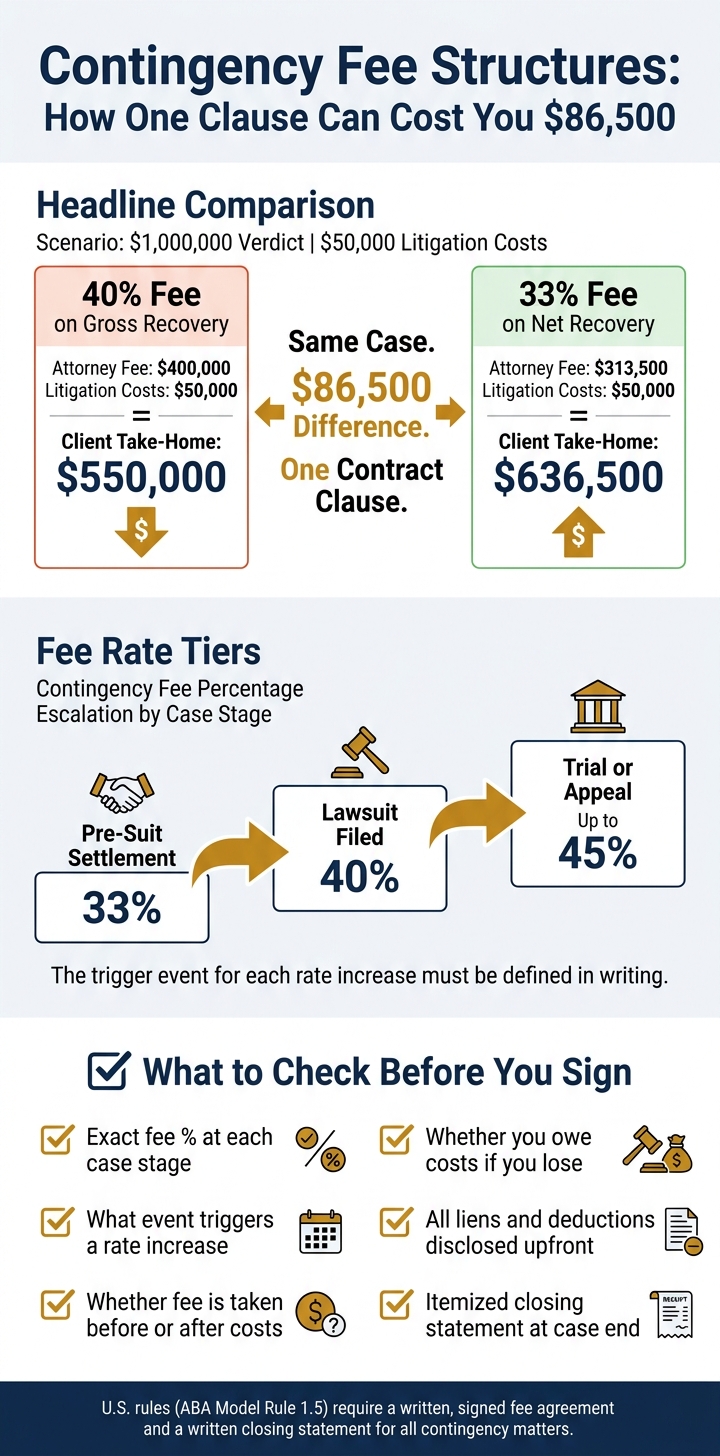
Contingency Fee Structures: How One Clause Can Cost You $86,500
How Injury Lawyers Get Paid: Contingency Fees Explained
sbb-itb-22d0d6e
Quick comparison
| What to check | What you want to see |
|---|---|
| Fee percentage | The exact rate at each case stage |
| Timing of fee increase | The event that triggers a higher rate |
| Costs | A list of common expenses |
| Fee math | Whether the fee is taken before or after costs |
| Loss outcome | Whether you still owe case costs if recovery is $0 |
| Final payout | An itemized closing statement with every deduction |
If I were reading this as a client, I’d want one thing before signing: a plain-English dollar example showing what my net check could look like.
The problem: where clients get confused about legal fees
Even with a written agreement in place, clients can still miss what the deal actually means for their money. The snag usually isn't the headline percentage. It's the missing detail around deductions, shifting rates, and when each charge kicks in.
Percentages alone do not show the client's net recovery
A fee like 33⅓% or 40% tells you the lawyer's cut. It does not tell you what lands in the client's pocket.
That's because contingency fees are often tiered. The rate may change as the case moves through each stage. A pre-suit settlement might come with a 33% fee. Once a lawsuit is filed, that can jump to 40%. Some agreements go as high as 45% if the case reaches trial or appeal.
Then there's another detail that can change the math in a big way: is the fee taken before costs or after costs?
Take a $1,000,000 verdict with $50,000 in litigation costs:
| Fee Structure | Attorney Fee | Litigation Costs | Client Take-Home Amount |
|---|---|---|---|
| 40% fee on gross recovery | $400,000 | $50,000 | $550,000 |
| 33% fee on net recovery | $313,500 | $50,000 | $636,500 |
That's a gap of more than $86,500 based on one line in the agreement: is the fee calculated before or after costs are deducted? For a client, that isn't fine print. That's a life-changing number.
Expenses, deductions, and liens can be unclear
Costs come out of the client's share too, and they can add up fast. Court filing fees usually run $200–$500. Depositions often cost $1,000–$5,000 each. Expert witnesses, including accident reconstructionists, forensic economists, and medical experts, often cost $5,000–$20,000 per expert. In complex wrongful death cases, total litigation costs can hit $30,000–$80,000 or more.
Liens and unpaid medical bills can shrink the client's payout even more. A stark example came in August 2026, when a $20 million settlement for 13-year-old Joshua Mora in a Los Angeles hit-and-run case showed how many deductions can pile on at once. About $9 million went to attorney fees, $72,000 was deducted for a Medi-Cal lien, and $4.5 million was placed into a trust. That left a $6 million lump sum for the family.
A lot of clients also miss one key question: what happens to case expenses if the case is lost?
As Ralph Manginello, Managing Partner at Attorney911, explains:
"The lawyer may advance those costs and may not recover them if the case is lost."
But not every firm handles it that way. Some agreements say the client still has to repay advanced costs even if the recovery is zero. That's the kind of clause people skim past without realizing what it means.
Transparent vs. opaque contingency fee practices: a comparison
| Feature | Transparent Practice | Opaque Practice |
|---|---|---|
| Whether the fee is based on gross recovery or recovery after costs | States clearly whether the fee is calculated before or after expenses. | Vague about the order of deductions. |
| When the fee percentage increases | Specifies exactly when the percentage increases, such as when a lawsuit is filed. | Mentions higher trial fees without defining the trigger. |
| Whether costs are owed if the case is lost | Confirms in writing whether costs are owed if the case is lost. | Leaves zero-recovery obligations ambiguous. |
| Upfront disclosure of liens and expenses | Lists known liens and other deductions upfront. | Doesn't clearly explain deductions until the end. |
| Net recovery example | Provides a written dollar-amount hypothetical showing take-home pay. | Presents the percentage only, with no dollar illustration. |
| Closing statement | Delivers an itemized statement of every deduction at case end. | Provides little explanation of the final deductions. |
That gap is exactly what disclosure rules are meant to fix.
The rules: what U.S. fee transparency requires
In the U.S., contingency fee rules require written disclosure before a case starts. That matters because vague fee talk can leave clients guessing. The written agreement is there to spell things out from day one.
What ABA Model Rule 1.5 requires in contingency matters
ABA Model Rule 1.5 says there must be a written agreement signed by the client. That agreement needs to clearly state the percentage the lawyer will receive at settlement, trial, or appeal. It also must say whether case expenses come out before or after the contingency fee is calculated, and whether the client will be on the hook for any expenses no matter how the case ends.
When the case is over, the lawyer must provide a written closing statement. That statement has to show the result, the amount paid to the client, and how that amount was calculated. As James Montee, Founder of Montee Law Firm, puts it:
"A contingency fee agreement must be in writing, signed by the client, and clearly address... whether litigation expenses are deducted before or after the percentage is applied."
How state bar rules reinforce written fee disclosure
State bar rules add local enforcement on top of that. In Missouri, for example, a contingency fee agreement must be written, signed, and clear about both fee terms and expense terms.
Rule-based expectations vs. risky fee practices: a comparison
| Feature | Compliant Practice (ABA 1.5) | Risky Practice |
|---|---|---|
| Written and signed | Written and signed by the client | Verbal-only or informal handshake deals |
| Set for each stage | Clearly stated for settlement, trial, and appeal | Vague "standard fee" with no defined tiers |
| States when costs are deducted | Explicitly states whether costs come out before or after the fee | Unclear order of deductions |
| Zero-recovery costs | States in writing whether the client owes costs if the case is lost | Leaves cost liability ambiguous |
| Itemized closing statement | Written statement showing the outcome and how the amount was determined | Lump-sum check with no breakdown |
The next step is making those required terms easy to understand before signing.
The solution: how to make contingency fees clear before a case begins
Knowing the rules is one thing. Making them easy for a client to grasp is something else.
That’s where confusion usually starts: the agreement may be compliant, but not clear. The fix is pretty simple. Put the money in plain numbers before anyone signs.
Use plain language and written dollar examples
Terms like "gross recovery" and "net proceeds" trip people up. Most clients don’t think in legal labels. They think in dollars.
So instead of leaning on percentages alone, show the fee with a written dollar example before signing. On a $90,000 settlement at a one-third rate, the attorney would receive $30,000, leaving $60,000 before expenses are deducted.
That kind of example makes the math click right away. As Scott DeSalvo, Founder of DeSalvo Law, puts it:
"Accuracy serves you better than false comfort."
A 33% fee can sound fine in the abstract. On paper, with the split spelled out in dollars, it lands very differently.
List expenses and legal funding terms upfront
The agreement should spell out the kinds of costs a client may face, such as court filing fees, medical record retrieval, deposition costs, and expert witness fees. Filing fees are often $200–$500, and expert witness costs in more complex cases can range from $5,000 to $25,000 per expert. A vague phrase like "case expenses" doesn’t tell a client much.
The same goes for legal funding. If a client is taking an advance on an expected recovery, those terms need to be in writing before the case starts, not later.
Interest type changes the total in a big way. Simple interest on a $50,000 advance at 3% monthly would total $104,000 after 36 months. Compound interest at the same rate would grow to $144,858 over that same period. That difference needs to be shown upfront in plain numbers.
It should also be stated, in direct language, whether the client still owes costs if the case is lost. Some firms cover those costs. Others expect repayment no matter the outcome. Clients need to know which rule applies before they sign. Any advance tied to the case should be handled with that same level of detail.
Provide a final itemized statement at the end of the case
When the case ends, the client should be able to see exactly how the final number was reached.
The closing statement should itemize:
- the gross recovery
- the attorney fee
- each expense
- each lien repayment
- the final net check
That’s the level of clarity clients need at the end of the case. And frankly, it’s the same level they should be getting before they ever sign a contingency agreement.
Putting transparency into practice with Million Dollar Case
How clear pricing and structured plans build client trust
You can see this idea in a simple place: pricing before a client commits.
Million Dollar Case puts its pricing upfront. The Basic Plan costs $500 per case or $4,000 per year. Custom Plan pricing is set case by case.
That kind of clarity matters. A client shouldn't have to dig through fine print or wait until the last minute to learn what something costs. When pricing is clear from the start, trust has a much better chance to grow.
How storytelling, lawyer access, and funding support clarity
A fee percentage by itself doesn't tell someone what they may actually take home. It doesn't show likely net recovery.
That's where context helps. Its lawyer directory and success stories give clients a better way to judge outcomes by offering a clearer reference point for case value and what they are likely to receive.
Clarity also needs to go past the legal fee. Funding terms and case support matter too, especially for clients who are already under stress. The platform connects clients with legal funding sources and pre-qualifies clients for funding. Just as important, it presents the terms in writing before they move forward.
Conclusion: clear fee terms protect clients and strengthen legal relationships
Clear pricing, clear funding terms, and clear case support cut down on surprises. That puts clients in a better position to say yes with confidence.
FAQs
What does “after costs” mean?
In a contingency fee agreement, “after costs” means the money left from a settlement or verdict after case expenses are taken out.
Those expenses are separate from attorney fees. They can include:
- Court filing fees
- Medical records fees
- Expert witness fees
- Deposition costs
Why does this matter? Your lawyer may figure their fee based on the total recovery or the amount after costs. That can change how much money you take home, so read the written agreement closely before you sign.
Can I owe case costs if I lose?
Under a contingency fee agreement, you usually don't pay attorney fees if you lose. But case costs are a separate issue.
Those costs can include things like:
- filing fees
- medical records
- expert witness expenses
Whether you have to pay those costs depends on your contract.
Some law firms absorb those expenses if the case doesn't work out. Others expect you to repay them. That's why it's smart to read the written fee agreement closely and ask the attorney to explain exactly what you would owe, if anything, before you sign.
What should a closing statement include?
A closing statement should clearly show the financial outcome of your case.
That means laying out:
- the total recovery
- the agreed contingency fee percentage
- an itemized list of any litigation expenses
It should also say whether those expenses were deducted before or after the fee was applied, because that changes your final take-home amount. Million Dollar Case stresses this kind of transparency.