To qualify for plaintiff pre-settlement funding, you generally need an attorney, a supported civil claim, and a likely source of payment. My advice: confirm your attorney will share the required records before you apply. Your claim - not your credit score or paycheck - usually drives approval.
Here’s what I’d check first:
- Your right to the proceeds: You must be entitled to receive the recovery and have authority to apply.
- Your case: Records must support fault, losses, and a path to payment through insurance or defendant assets.
- Your paperwork: Gather ID, case records, medical bills, wage records, and details of liens or prior advances.
- Your likely payout: Attorney fees, expenses, liens, and funding charges reduce what you keep.
- Your contract: Have counsel check state rules, repayment triggers, privacy terms, and who controls case decisions.
Pre-qualification is not approval - and approval does not mean the offer fits your budget. In the article’s example, a $100,000 settlement leaves $37,000 after a 33% attorney fee, $15,000 in expenses and liens, and $15,000 in funding repayment.
Before signing, I’d ask for <u>written repayment totals at 6, 12, 18, 24, and 36 months</u>. Compare those costs with your likely payout, and request only what you need.
Can I Get Pre-Settlement Funding If There Are Multiple Wrongful Death Beneficiaries?
sbb-itb-22d0d6e
Applicant and Case Eligibility
After the basic checklist, providers confirm who can receive funds and whether the claim can generate enough money to repay the funding.
Applicant Requirements and Your Attorney’s Role
Applicants must have the right to receive the proceeds. A business applicant must also have authority to act for the entity. The plaintiff must have a licensed attorney who agrees to share case documents and sign the acknowledgment letter.
The provider cannot control your case. Your attorney retains control over all litigation decisions.
| Applicant responsibilities | Information or cooperation from counsel |
|---|---|
| Submit the application and contact details | Copy of the filed complaint and pleadings |
| Provide ID | Evidence of liability, such as police reports or witness statements |
| Sign the non-recourse funding agreement | Documentation of damages, such as medical bills or wage records |
| Authorize the attorney to share case files | Information on defendant insurance limits or assets |
| Keep attorney authorization current | Case value and expected timeline |
Once the applicant’s authority is confirmed, the provider reviews the claim’s strength and expected recovery.
Liability, Damages, and Ability to Collect
Underwriters review three main factors: liability, damages, and the ability to collect payment. Incident reports, witness statements, and expert reports help them assess liability. Medical bills, wage records, and life care plans document damages. Insurance policy limits and a corporate defendant’s assets or insurance help show whether payment is likely.
Court dockets and deposition transcripts show how far the case has progressed. Existing liens or prior advances can reduce the money available to repay new funding. Together, these factors help providers decide which claims qualify.
Case Types That May Qualify
Claims that commonly qualify include motor vehicle accidents, premises liability, medical malpractice, product liability, wrongful death, civil rights claims, and some commercial disputes.
Approval is harder when liability is disputed or documentation is thin. Criminal cases, most family law disputes - including divorce or custody - bankruptcy proceedings, and claims without a realistic monetary recovery generally do not qualify for plaintiff pre-settlement funding.
Financial Requirements and Legal Limits
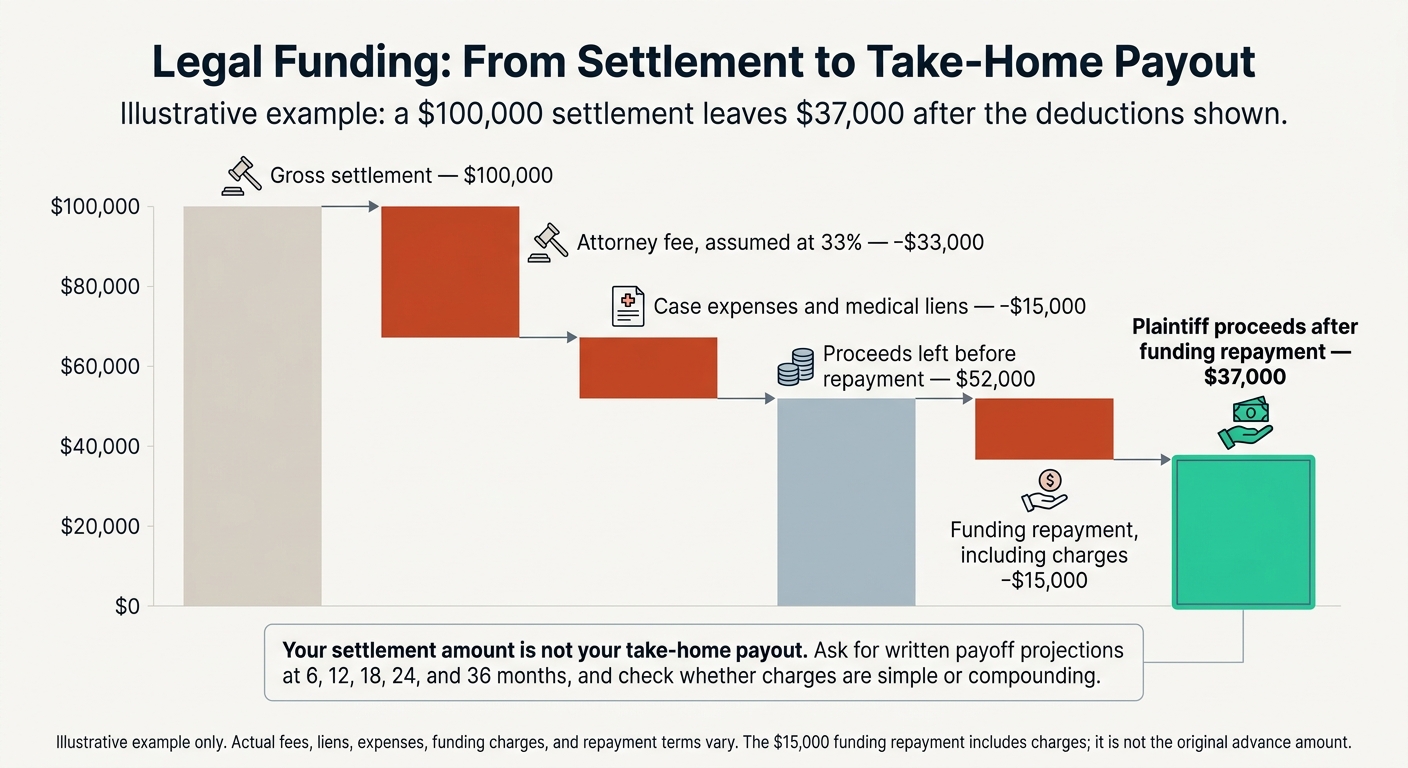
Legal Funding: From Settlement to Take-Home Payout
Once a claim is strong enough for review, the next step is to assess how much the case could repay.
Credit, Income, and Case Review
For non-recourse lawsuit funding, your credit, income, and employment usually matter little. Underwriters focus instead on liability, damages, collectability, and your attorney’s case file. Cases further along in discovery are often easier to assess because more information is available.
| Factor | Traditional loan screening | Lawsuit funding review |
|---|---|---|
| Credit score | Primary approval factor | Rarely considered |
| Income / employment | Used to show repayment ability | Irrelevant in non-recourse funding |
| What secures repayment | Personal assets or business revenue | The pending legal claim itself |
| Repayment | Due regardless of outcome | Due only if the case is won or settled |
| Key metric | Debt-to-income ratio | Liability, damages, and collectability |
Even a strong case can repay funding only from what remains after fees, liens, and prior advances.
Net Recovery and Advance Amount
Your settlement amount is not your take-home payout. Attorney fees, case expenses, medical liens, attorney liens, and prior advances reduce the net recovery available for repayment.
Item Amount Gross settlement $100,000 Attorney fee, assumed at 33% −$33,000 Case expenses and medical liens −$15,000 Proceeds left before repayment $52,000 Funding repayment, including charges −$15,000 Plaintiff proceeds after funding repayment $37,000
Ask for written payoff projections at 6, 12, 18, 24, and 36 months, and check whether charges are simple or compounding. Monthly rates are often 2% to 4% and may compound, so borrow only what you need - not automatically the maximum offered.
Financial approval is only part of the picture. The contract and state law set the repayment rules.
State Laws and Repayment Terms
The written agreement and state law control repayment details. Some agreements may require repayment after a voluntary dismissal or in cases involving fraud.
State rules may require itemized fee breakdowns and total cost projections. Some states also offer a short cancellation period before the agreement becomes final or limit these contracts under local law.
You’ll also need to check how records are shared and who controls the case.
Privacy and Attorney Independence
Have your attorney control which records are shared and require redactions or protective measures when needed. Sharing case records can put attorney-client privilege or work-product protection at risk, so counsel should oversee disclosures. Review the terms to ensure control of the case stays with counsel, not the funder.
Required Documents and Approval Steps
Once you’ve confirmed basic eligibility, gather the records the underwriting team will check.
Gather Applicant and Case Records
You’ll need government ID, your attorney’s contact details, a one-paragraph claim summary, details of any prior advances, the complaint or other filings, liability evidence, medical and wage records, insurance limits, and liens. Medical malpractice claims may also require expert reports.
Share sensitive records only through secure channels approved by your attorney.
From Screening to Final Approval
These records move your file from pre-qualification to underwriting. Pre-qualification is not final approval. Missing medical records, incomplete liability evidence, newly discovered liens, or changes to case facts can delay the review, lower an offer, or prevent approval.
| Stage | Minimum information reviewed |
|---|---|
| Initial screening | Claim summary, attorney contact details, case type |
| Attorney verification | Representation, case value and timing, counsel’s cooperation |
| Underwriting | Filings, liability evidence, medical and wage records, insurance limits, liens |
| Offer review | Advance amount, fees, repayment terms |
| Final approval | Signed agreement, attorney acknowledgment, final lien and prior-advance checks |
| Disbursement | Bank or wire details |
Pre-Qualification Through Million Dollar Case
Million Dollar Case can connect applicants with legal funding sources and help with pre-qualification. Final approval still depends on underwriting and the required documents.
Review the Agreement Before Signing
After approval, have your attorney review the contract line by line before you sign. Check the repayment triggers, fee structure, lien offsets, and any clauses tied to dismissal or fraud. Confirm that the funder cannot control litigation or settlement decisions.
Conclusion: Check Eligibility and Terms
Approval is only part of the test. What matters is how much money you could keep after repayment. Eligibility depends on a supported claim, cooperating counsel, and a realistic path to recovery.
Gather your records and confirm state-law compliance with your attorney. Ask for written repayment totals at 12, 24, and 36 months so you can estimate your net recovery. Before signing, compare those totals with your likely recovery.
Pre-qualification does not guarantee funding, and approval does not mean the offer is affordable. Make your decision based on the written terms and what you’re likely to keep after fees, liens, and funding charges - not the largest advance offered.
FAQs
Can I qualify before filing a lawsuit?
Generally, no. Most funding companies require a filed lawsuit and some completed discovery before they can evaluate your claim. Underwriters review the complaint, police reports, or other evidence to assess liability and potential recovery.
Million Dollar Case can explain these requirements and help you get pre-qualified for funding as your case moves forward.
What if my settlement cannot cover repayment?
If your settlement doesn’t cover the full repayment amount, your agreement determines what you owe. In many cases, repayment is capped at the available proceeds.
Legal funding is typically non-recourse: you repay only after a successful settlement or verdict. If you lose, you generally owe nothing. Check your contract for voluntary dismissal or fraud clauses. These can require repayment regardless of the case’s outcome.
Can I reapply if funding is denied?
You may be able to reapply, but first find out why your legal funding application was denied. A denial often comes down to missing case details or documents - not a judgment about you.
Million Dollar Case can help you get pre-qualified and connect you with funding sources. To improve your chances, make sure your attorney is ready to send the required records promptly, including medical reports or case filings.