Legal funding can change how a case plays out. In most cases, it gives a plaintiff cash upfront and gets repaid only if the case ends with money recovered. That can affect case prep, settlement pressure, timing, day-to-day stress, and access to experts and discovery.
Here’s the short version:
- Stronger prep: money may help pay for depositions, records, e-discovery, and expert work.
- More settlement pressure relief: a plaintiff may be less likely to take a low offer just to cover rent or medical bills.
- More control over timing: a case may have more time to develop before settlement talks end.
- Less money stress: funding may help with bills like groceries, transportation, and housing.
- More access to case support: expert witnesses and other case costs may be easier to afford.
There’s also a tradeoff: cost. Many legal funding deals charge about 2% to 4% per month, and the total payoff can grow a lot over time. I’d also check whether the rate is simple or compounding, and ask for payoff estimates at 12, 24, and 36 months before signing.
Legal Funding Explained: How Injury Clients Get Paid Before Settlement | Episode #355 Laura Moore
sbb-itb-22d0d6e
Quick Comparison
| Area | With legal funding | Without legal funding |
|---|---|---|
| Case prep | More room to pay for discovery and experts | More pressure to limit costs |
| Settlement talks | More room to wait on a low offer | More pressure to settle early |
| Timing | More flexibility to let treatment or facts develop | More pressure to move fast |
| Personal finances | Help with daily bills during the case | Bills may drive case decisions |
| Repayment | Often non-recourse if the case is lost | No funding cost, but no cash cushion |
Bottom line: legal funding does not win a case by itself. But it can give you more room to build the claim, handle delays, and make calmer settlement choices - if the fees make sense.
1. Stronger Case Preparation
Building a strong case costs money. Depositions, e-discovery, investigators, and expert witnesses all come with upfront bills. Without funding, lawyers may have to limit discovery or leave some evidence untouched.
Legal funding can help plaintiffs cover early litigation costs, bring in qualified experts in medicine, engineering, or forensic accounting, and build a stronger evidentiary record.
Insurance companies may also drag things out. Repeated motions and delayed depositions can wear down a plaintiff's finances over time. Funding gives plaintiffs more room to keep litigating through those delays.
That can make a big difference when a case turns on preparation. A better-prepared case puts plaintiffs in a stronger spot once settlement talks start. It can also give them more leverage at the negotiating table.
2. More Leverage in Settlement Talks
Legal funding can help plaintiffs stay at the table longer during settlement talks. Once the case is built, that money can make it easier to push back against low offers.
This matters most when negotiations start. Defense teams - especially insurance companies - often lean on delay. They file endless motions, put off depositions, and wait for rent, medical bills, and grocery costs to pile up for the plaintiff. When that happens, even a low settlement can start to look like a lifeline.
Legal funding helps blunt that tactic. If a plaintiff isn't scrambling to pay daily bills, the defense loses one of its main pressure points. In practice, that can shift talks closer to the case's actual value.
That financial cushion also gives plaintiffs more say in when to settle.
3. More Control Over Case Timing
That same cushion gives plaintiffs more control over case timing. With funding in place, they have room to let the case play out instead of rushing it.
It can also help keep discovery moving, rather than pushing someone toward an early settlement just to cover bills.
This matters even more when damages are still taking shape. In personal injury cases, attorneys often wait until treatment ends before making a demand. If a plaintiff is under heavy money pressure, that wait may feel impossible. Funding can ease that pressure and give them time to hold off.
And that extra time can lead to a better result.
4. Less Financial Stress During a Case
That timing edge can also ease the day-to-day money strain that builds up during a case. And that matters, because financial pressure can push plaintiffs into rushed choices.
Legal funding can help cover rent, groceries, medical bills, and transportation. In plain terms, it gives people some breathing room and cuts the pressure to settle too soon. It can also blunt delay tactics aimed at wearing someone down until they accept a low offer.
That kind of stability can change the attorney-client dynamic, too. When clients aren't making urgent calls about overdue bills, attorneys can spend more time on case strategy instead of crisis management. Less stress can also lead to steadier communication and more disciplined settlement decisions.
5. Better Access to Key Resources
Financial stability does more than help with day-to-day bills. It can also pay for the work that makes a legal claim stronger.
Legal funding can cover key case costs, including expert witnesses, depositions, and records retrieval. Those resources can help prove liability and damages. In more complex cases, the right specialist can make a big difference. A medical malpractice case, for example, may hinge on credible medical expertise, while other claims may call for engineers or forensic accountants. That kind of support can shape what evidence gets built and how convincing the claim is.
On the personal side, funding can also help cover living expenses while the case is pending. That breathing room can help plaintiffs stay focused on the case instead of taking a low offer just because money is tight.
Most legal funding is non-recourse, which means the plaintiff owes nothing if the case is lost. The catch is the cost: monthly rates usually run from 2% to 4%, and that can grow fast over a multi-year case. Before signing, ask for a written payoff estimate at 12, 24, and 36 months.
With Legal Funding vs. Without It: A Quick Comparison
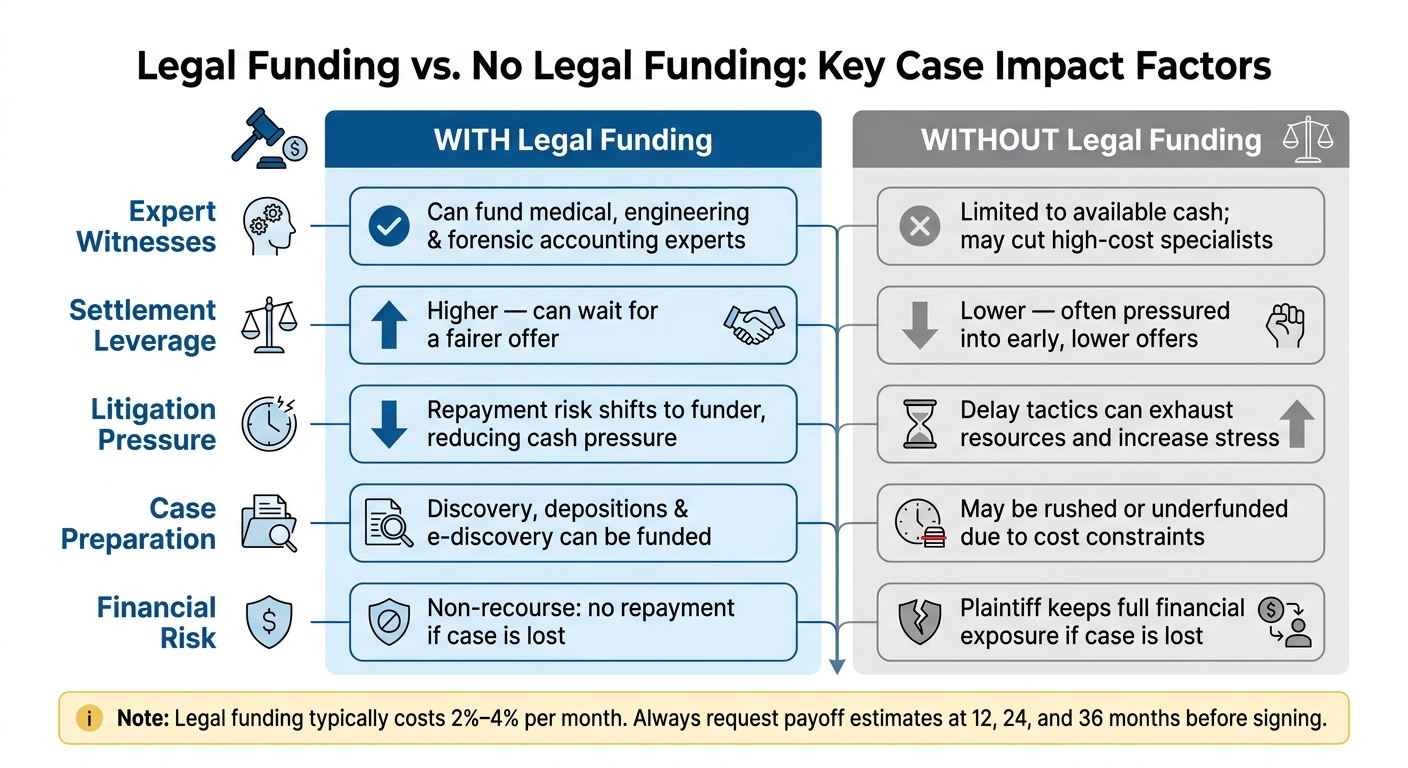
Legal Funding vs. No Legal Funding: Key Case Impact Factors
A side-by-side look makes the gap easier to see. The difference stands out fast when you compare both paths directly.
| Factor | With Legal Funding | Without Legal Funding |
|---|---|---|
| Expert Witnesses | Can fund experts in medicine, engineering, or forensic accounting | Limited to available cash; may cut high-cost specialists |
| Settlement Leverage | Higher; can wait for a fairer offer | Lower; often pressured into early, lower offers |
| Litigation Pressure | Repayment risk shifts to the funder, reducing cash pressure | Delay tactics can exhaust resources and increase stress |
| Case Preparation | Discovery, depositions, and e-discovery can be funded | May be rushed or underfunded due to cost constraints |
| Financial Risk | Non-recourse; no repayment required if the case is lost | Plaintiff keeps full financial exposure if the case is lost |
That shift can help level the playing field. But there’s a price tag attached: monthly rates usually run from 2% to 4%, and the total cost grows the longer the case stays open.
Conclusion
Legal funding doesn't win cases. Preparation, evidence, and strategy do. What funding can do is take some of the money pressure off your shoulders, so you're less likely to make rushed choices. It can give you time to wait, prepare your case with care, and negotiate from a stronger spot.
That upside matters most when the cost stays under control. Fees can climb fast, especially when the funding uses compounding.
Before you sign anything, ask for a written payoff estimate at 12, 24, and 36 months. Also confirm whether the rate is simple or compounding, and check for any partial recourse clause that could leave you owing money if you dismiss the case or switch attorneys.
That's why attorney review matters. Talk to your attorney first so they can look over the paperwork and decide whether the terms line up with your expected recovery. Million Dollar Case can also help connect you with funding sources and pre-qualify you for legal funding.
Used with care, legal funding can help support a stronger case without adding avoidable financial strain.
FAQs
How does legal funding affect settlement decisions?
Legal funding lets you weigh a settlement based on what your case is actually worth, not just the pressure of bills due right now. When it helps cover basic living costs, it can blunt one of the insurer’s favorite plays: dragging things out and hoping you’ll take a low offer just to get by.
With rent, groceries, and other must-pay expenses handled, you and your attorney have more room to wait instead of settling too early. That matters, because a rushed deal often leaves money on the table. Reputable funders stay in the background and do not direct legal strategy or decide whether you should settle.
What should I check before signing a funding agreement?
Review the contract with care so you know exactly what you’re agreeing to. Focus on the full cost of the funding, including fees, interest, total repayment, and any risks tied to the deal. Ask the funder to spell out the numbers in plain English, including repayment estimates for 12, 24, and 36 months. You’ll also want to confirm whether interest is simple or compound, and whether any hidden fees could show up later.
A few points deserve extra attention:
- Check for partial recourse clauses.
- Confirm the funder has no control over legal or settlement decisions.
- Review the full agreement with your attorney before signing.
This step matters more than many people think. A contract can look straightforward at first glance, then hide extra costs in the fine print. Having your attorney review it can help you catch issues early and avoid a bad surprise later.
Can legal funding help pay for experts and discovery?
Yes. Legal funding can help cover expert witness fees and discovery costs as part of case expenses.
That support can give your legal team room to keep moving on key investigation and evidence-gathering work, instead of slowing down because of cash flow problems.