The short answer: flat fees work best when the job is clear, and hourly rates work best when the case may change. If I were choosing between them, I’d focus on four things first: scope, extra costs, staffing, and whether unused retainer money comes back.
Here’s the core idea in plain English:
- Flat fee = one set price for a defined job
- Hourly rate = you pay for time spent, often in 6-minute or 12-minute increments
- Flat fees give more price certainty
- Hourly billing puts more cost risk on you
- Both models can still include extra charges, like:
- court filing fees
- service of process
- deposition transcripts
- expert witness costs
A higher hourly rate does not always mean a higher total bill. For example, a lawyer billing $500/hour for 8 hours costs $4,000. A lawyer billing $200/hour for 20 hours also costs $4,000. Time matters just as much as rate.
If I were reviewing a fee agreement, I’d ask:
- What exact work is included?
- What is excluded?
- Who will work on the case, and at what rate?
- How often will I get bills or updates?
- Is there a fee cap?
- How are scope changes approved?
- Are unused retainer funds refundable?
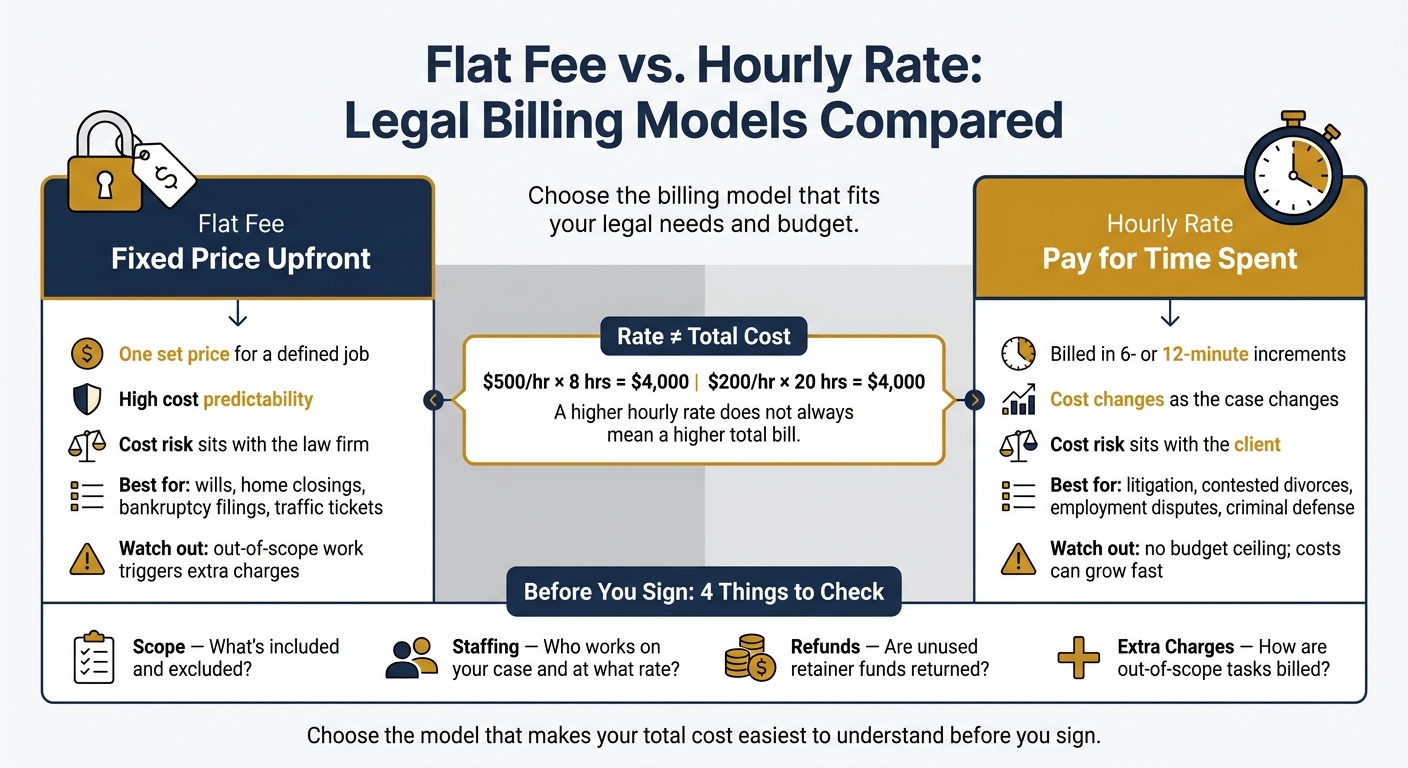
Flat Fee vs. Hourly Rate: Legal Billing Models Compared
Flat Fee or Hourly? Understanding Legal Costs Before You Sign
sbb-itb-22d0d6e
Quick Comparison
| Point | Flat Fee | Hourly Rate |
|---|---|---|
| Price | Fixed upfront | Changes with time spent |
| Best for | Simple, defined work | Cases with moving parts |
| Cost risk | More on the law firm, within scope | More on the client |
| Billing | One set amount per task or phase | Time-based billing by role |
| Main issue to watch | Out-of-scope work | Total cost can grow fast |
Bottom line: I’d pick the model that makes my total cost easiest to understand before I sign.
Flat fees: fixed pricing for clearly defined legal work
Flat fees make the most sense when the work is clear from the start and the task tends to follow a predictable path. In this setup, the client pays one fixed price for a defined job, with no time-based billing. That kind of price certainty is strongest when the matter is routine and the scope stays narrow.
Where flat fees work best for clients
Flat fees are often a good fit for routine, well-defined matters like wills, home closings, bankruptcy filings, and traffic tickets.
The biggest plus for clients is simple: you know the total cost before you commit. That makes budgeting easier and lowers the chance of bill shock. But that clarity only holds if the agreement spells out the scope in plain terms. That's where things can get fuzzy.
Always check what the flat fee actually includes. Look closely at whether court appearances, document revisions, or filing fees are part of the deal. For example, some traffic attorneys include the initial hearing and one additional hearing.
Common limits and scope issues with flat fees
The main risk comes from extra work outside the agreement - when the case grows beyond what the original deal covered, sometimes called scope creep. A flat fee may leave out added work if the matter expands past the original scope.
Written exclusions matter here. Before you sign a flat fee agreement, confirm how any added work will be billed.
Hourly billing works in a different way because the final cost depends on how much time the case ends up taking.
Hourly rates: pay for time when the case may change
Hourly billing makes sense when the scope is hard to pin down and the total cost can't be set on day one. That's common in litigation, contested divorces, employment disputes, and criminal defense. In this setup, the client takes on the cost risk. So the fine print matters. Your retainer, billing increments, and each team member's rate all shape what you end up paying.
How hourly billing works in practice
Most firms bill in 6-minute or 12-minute increments under the retainer agreement. Each task gets tracked and billed, whether that's drafting a motion, reviewing documents, or doing research.
Rates usually vary by role. Partners, associates, and paralegals often bill at different amounts, which means staffing choices can change the total bill. Most hourly matters also begin with a retainer - an upfront payment kept in a trust account. Your attorney withdraws from that fund only after billable work is done, and if money is left at the end of the case, it comes back to you.
On top of attorney time, you should also expect case costs like:
- Court filing fees
- Service of process for a summons
- Deposition transcripts
That setup helps explain why hourly billing can feel flexible, but also why costs can drift upward.
The main advantage and risk of hourly billing
The main upside is simple: you pay for the time the case actually takes. If things settle early, you don't get stuck paying a flat fee based on a messy, drawn-out version of the case.
And here's where rate alone can be misleading. A skilled attorney at $500 per hour who finishes a motion in 8 hours costs the same as a less experienced attorney at $200 per hour who takes 20 hours to do the same job. A higher hourly rate doesn't always mean a higher final bill.
The downside is just as plain. Without a cap or estimate, costs can grow fast once litigation gets busy. That's why it's smart to watch estimates, staffing, and invoices closely. From there, it makes sense to compare this model directly with flat fees.
Flat fees vs. hourly rates: a side-by-side comparison
Once you know the billing basics, the contrast between these two models becomes pretty clear. Flat fees lock in the price upfront. Hourly billing leaves the total open until the work is finished. The big issue is risk: with hourly billing, the client takes on more of the cost risk; with flat fees, more of that risk sits with the firm.
| Feature | Flat Fee | Hourly Rate |
|---|---|---|
| Predictability | High; cost is set before work begins | Bills change as the case changes |
| Billing method | Fixed price per task or litigation phase | Billed in time increments, with rates that can differ by role |
| Cost risk | Firm absorbs overruns within scope | Client absorbs all additional time costs |
| Common risks | Out-of-scope tasks like appeals or expert fees can trigger extra charges | Overstaffing or unnecessary motions can inflate the bill |
The next step is simple: look at whether the fee agreement gives you enough detail to compare offers in a fair way.
How standardized fee disclosures make comparisons easier
A written fee agreement or fee disclosure is what lets you compare one proposal to another. Without it, you're stuck guessing about scope, exclusions, or the total cost.
A good disclosure should spell out the billing model, the services included, what is excluded, how out-of-pocket costs are handled, and whether those costs are separate from the base fee. For flat-fee agreements, it should name the exact tasks or phases covered. For hourly setups, it should list the rates for each role - partner, associate, paralegal - so you can compare proposals side by side on price certainty, scope, exclusions, and cost risk.
"A retainer agreement is a legal contract that lays out what will happen in the event that you decide to retain the law firm... it tells you exactly how you'll be billed." - Hofheimer Family Law Firm
That kind of detail is what makes one lawyer's proposal stack up against another in a way that actually means something.
What to check before signing a fee agreement
Before signing, focus on four things: scope, staffing, refunds, and extra charges. These points can shape what you pay just as much as the headline fee.
- Scope: Confirm exactly what is included and what is not. A flat fee for DUI defense may cover discovery and trial but exclude appeals or expert witness fees.
- Staffing: Find out who will actually work on your case and what their rates are. Under hourly billing, staffing choices have a direct effect on your total bill.
- Refunds: Verify whether any unused retainer funds are refundable. In many cases, the unused portion of a retainer held in trust should be returned if the representation ends early.
- Extra charges: Ask how out-of-scope tasks get billed - whether that's a separate hourly rate or a fixed add-on.
Pros and cons of flat fees and hourly rates
The main tradeoff is simple: flat fees give you price certainty, while hourly rates give you more billing flexibility. Once that part is clear, the next thing to look at is risk. In plain English, which setup leaves you more exposed if the matter takes longer or gets messier than expected?
| Billing Model | Best for | Main watchout |
|---|---|---|
| Flat Fee | Routine, well-defined matters with upfront cost certainty | Out-of-scope tasks can trigger extra charges |
| Hourly Rate | Unpredictable cases where scope may shift | No budget ceiling; the client carries the financial risk |
Your fee disclosure should spell out that tradeoff before you sign. That matters because a flat-fee setup also cuts down the incentive to bill more hours.
When a flat fee may cost more or less than hourly billing
Flat fees usually work best for predictable legal work. If the job is clear from the start, a flat fee can make costs easier to plan.
Hourly billing can end up costing more when the matter grows beyond the first estimate. Discovery delays, motion practice, or changes in scope can push the total far past the original expectation. On the flip side, if the matter stays narrow and wraps up fast, hourly billing may come in lower than a flat fee. That’s why the facts of the case matter so much here.
Questions to ask before choosing either billing model
Before you choose, look closely at the contract terms that shape your total cost. A few questions can save you a lot of stress later:
- Fee cap: Can the lawyer place a cap on hourly fees so your total exposure doesn't keep climbing if the case runs long?
- Phase-based pricing: Can a more complex matter be split into separate flat fees for discovery, pre-trial, and trial?
- Scope-change approval: How will scope changes be approved and billed?
- Billing-update frequency: How often will you get billing updates?
Conclusion: choose the fee model that fits your case and budget
The right billing model comes down to one question: how predictable is your matter? Flat fees tend to fit routine, standardized work like a simple will, a house closing, or a straightforward Chapter 7 bankruptcy. Hourly rates usually make more sense when the scope is uncertain and the matter could grow or turn contested.
A lot hangs on what the fee agreement actually covers. Written fee disclosures should spell out scope, rates, billing increments, and exclusions. In both models, scope is what shapes cost.
Before you sign, confirm any separate costs and ask how changes to the case will affect billing.
Price certainty and billing flexibility are real tradeoffs - neither model is always better. Pick the one that makes your cost exposure easiest to understand.
FAQs
Can a flat fee change later?
Sometimes. A flat fee is meant to give you a set price for certain legal services, but that price can shift if the scope of work in your agreement changes.
In most cases, it covers only the services spelled out in the agreement. It may not include added costs like expert witness fees, depositions, or appeals. If your legal matter grows beyond what was first agreed on, your lawyer may charge extra fees.
What does a retainer actually cover?
A retainer is an upfront payment for legal services. In most cases, it's based on the number of hours the lawyer expects to spend on your case, and the money is usually kept in a trust account. As the work gets done, the attorney draws payment from that account.
That retainer may also be used for case-related costs, such as filing fees, deposition reports, and expert witness expenses. But it doesn't always cover everything. As the case moves along, you may need to put in more funds to cover added work or extra costs.
Should I ask for a fee cap?
Yes - you can, and should, talk through fee structures with your attorney.
One common option is a fee cap. That sets a limit on what you'll pay and makes hourly billing less of a moving target.
Many attorneys are open to setups that give both sides more clarity. For example, they may agree to cap fees for a certain phase of a case or charge a flat amount for specific services.
It helps to bring this up early. That way, you can line up expectations before work gets underway.