I’d use attorney reviews to build a shortlist - not make the final hiring decision. A 5-star score alone won’t tell you whether a lawyer handles your type of case. I’d compare recent feedback, check the lawyer’s state bar record, and get fees in writing.
These sites offer three different kinds of information: client feedback, peer ratings, and selected case results. Here’s how I’d use each:
Quick Comparison
| Site | What I’d check | Main limit |
|---|---|---|
| AttorneyReview / LegalMatch | Lawyer matches and client feedback | Confirm which platform hosts the listing and what “verified” means |
| Avvo | Profiles, credentials, and client reviews | Its attorney rating differs from its client-review score |
| Martindale-Hubbell | Client feedback and peer ratings | Peer ratings don’t measure client service |
| Lawyers.com | Local profiles and client feedback | Verify profile claims and licensing separately |
| FindLaw | Lawyer profiles and legal guides | Not every profile has client reviews |
| Google Business Profile | Recent local reviews and firm replies | Reviews don’t prove an attorney-client relationship |
| Yelp | Comments about communication and billing | Sparse or repeated comments offer less help |
| Best Lawyers | Peer recognition by year and practice area | Awards don’t tell you about fees or responsiveness |
| Million Dollar Case | Directory listings, case stories, and pricing | Past results aren’t promises; confirm fees and funding terms |
My rule: <u>match the source to the question</u>. I’d use client reviews to assess service, peer ratings to check professional standing, and case stories to ask about relevant experience. Before hiring, I’d confirm the lawyer’s license, disciplinary history, case fit, and written terms for fees, expenses, and communication.
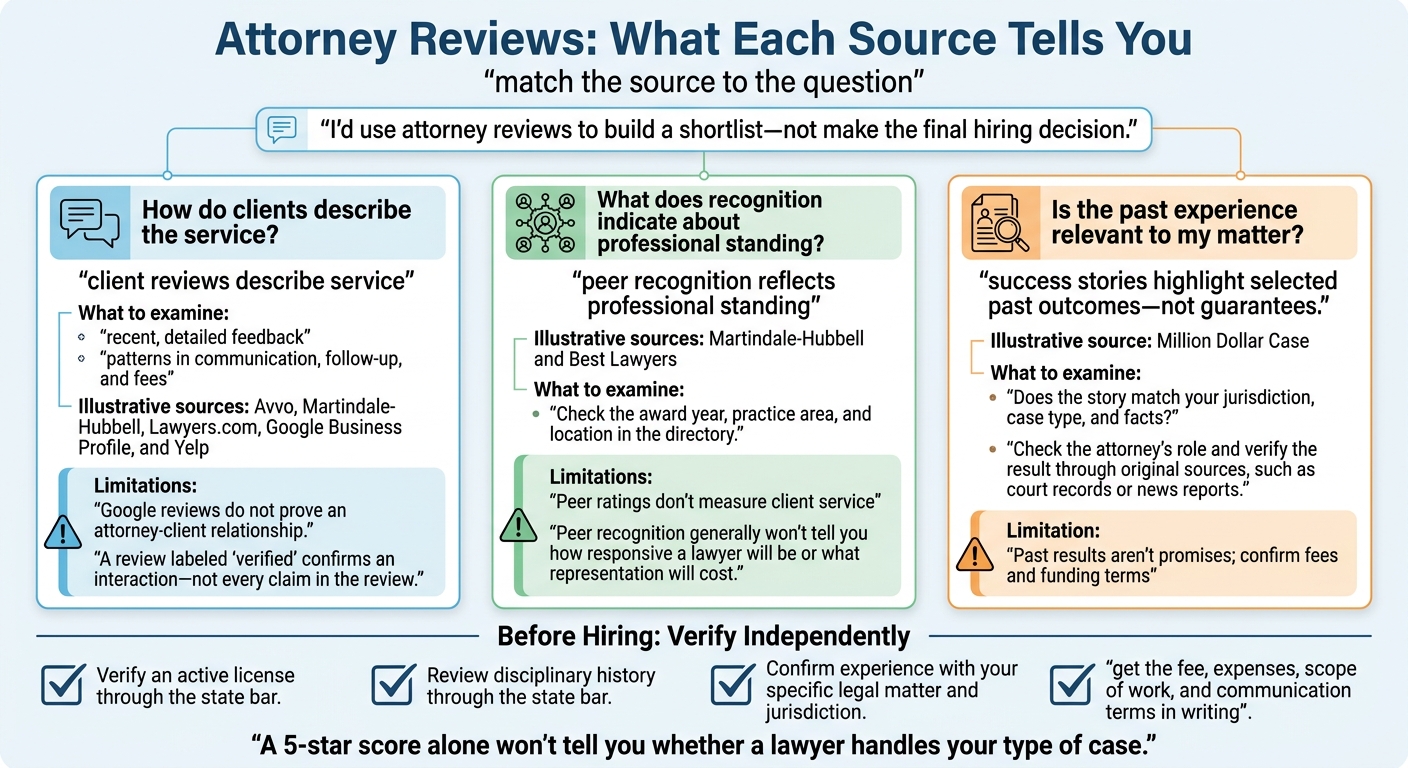
Attorney Reviews: What Each Source Tells You
How to Assess Attorney Review Sites
Use these checks to assess each site in the roundup below and separate client experiences from marketing.
Check what “Verified” means. The label usually means the platform confirmed a real client interaction. It doesn’t confirm the lawyer’s overall quality.
Review Types and Verification Methods
Before comparing sites, decide what you need to learn. Client reviews describe service, while peer ratings reflect professional standing. Success stories should be tied to documented results.
| What to check | What to look for | Why it matters |
|---|---|---|
| Review type | Client reviews, peer ratings, or case results | Each measures something different |
| Verification method | “Verified” labels, peer-review methodology, or links to original sources | Helps you judge how much to trust the information |
| Response and moderation policies | How the site handles suspicious reviews and whether attorneys can reply | Shows how the platform deals with criticism and fraud |
| Scoring and visibility | How the site explains rankings and whether it discloses paid placement | Helps you avoid mistaking visibility for quality |
| Profile details | Practice area, office location, and current contact information | Helps confirm the listing matches the lawyer you want to contact |
Separate visibility from ratings. Check whether rankings reflect reviews or paid placement.
If a site publishes success stories, check the source behind each result before relying on it.
For Million Dollar Case, treat success stories as case-specific proof - not a promise. Check the source link, then see whether the result matches your case type and jurisdiction.
sbb-itb-22d0d6e
AttorneyReview: Client Reviews and Lawyer Search
LegalMatch connects clients with pre-screened local lawyers based on case details. Check that the listings include local lawyers who handle your type of case. Then use those details to see whether the reviews relate to your case type and location.
A review labeled “verified” confirms an interaction - not every claim in the review.
Once you’ve checked the listing, look for concrete details about the service. The strongest reviews describe direct communication with the attorney and how the attorney handled the case.
Read recent reviews and attorney replies for signs of current service quality and active firm management.
Avvo: Attorney Profiles and Client Reviews
Avvo lets you search for attorneys by practice area and location. Its profiles bring together credentials and client reviews, making it a useful starting point before you verify a lawyer’s background in more detail.
Look at each profile’s certifications, honors, and publications to assess the lawyer’s background.
Avvo’s rating and its client-review score are different measures. Avvo bases its rating on profile data, while client feedback appears separately as star ratings.
Check the star rating alongside the number of reviews.
Martindale-Hubbell: Client Feedback and Peer Ratings
Martindale-Hubbell brings together attorney profiles, client feedback, and peer ratings. Check a lawyer’s biography and practice areas to see whether they fit your needs. Expanded listings may include firm details, links, and practice summaries, giving you more to check beyond client comments.
Practice-area descriptions may be self-reported. Use them as a starting point, not proof that a lawyer is right for your matter.
Martindale-Hubbell lets you review peer recognition alongside client feedback, but read the two separately. Peer ratings address professional standing, while client reviews describe service quality. Look for comments about case updates, returned calls, and clear billing.
Check Martindale-Hubbell’s methodology, too. Its peer ratings draw on nominations, research, and peer evaluations - not client experience.
Lawyers.com: Lawyer Profiles and Client Feedback
Use Lawyers.com to filter lawyers by location and practice area, then check that they handle your case type. Build a shortlist from the listings, but verify reviews and bar status before contacting a firm.
Look for profile details that point to relevant experience, including specialized certifications and case results you can verify. Treat these as starting points, not proof. Ask the attorney to confirm those details and explain how their experience fits your case.
Next, read recent client feedback for details that match your issue. A profile with only five-star reviews posted within a short period may signal astroturfing or fake reviews.
Check whether the consultation is free. Before moving forward, get contingency fees, trial increases, and cost deductions in writing.
Verify active licensing and disciplinary history directly through the state bar. Don’t rely on the directory listing for this check.
FindLaw: Lawyer Search and Legal Guides
FindLaw puts lawyer profile basics and legal background reading in one place. Its standardized profiles help you compare services, credentials, and office details.
Not every profile includes client reviews. Attorney bios and awards provide background, but they aren't client feedback. Bios are self-reported; reviews reflect client experience.
FindLaw’s Legal Guides explain legal topics - not lawyer quality. Use them to work out which reviews matter for your case, what to verify, and which questions to ask during a consultation.
Before hiring an attorney, confirm their experience with your specific legal matter and jurisdiction.
Google Business Profile: Local Law Firm Reviews
Google Business Profile is a good starting point for checking a law firm’s local reputation. Search Google Maps by practice area and city or county, then open the firm’s Business Profile. Look at the review count and star rating together.
Sort reviews by most recent to get a sense of current service. Watch for a sudden burst of 5-star reviews within one month, repeated wording, or ratings clustered at 5 and 1 stars.
Three-star reviews often describe both strengths and weaknesses. Repeated complaints about surprise bills or missed follow-ups deserve more attention than one vague criticism.
Check how the firm replies to criticism. A professional reply that offers a private way to get in touch tells you more than a generic apology or public argument. A high response rate may show that the firm monitors its reputation, but it doesn’t prove that complaints were resolved.
Google reviews do not prove an attorney-client relationship. Non-clients and former employees may also post reviews. Treat those reviews as reputation signals, and check the lawyer’s license and disciplinary history through the state bar’s official records.
Yelp: Reviews of Client Service
Yelp can help you gauge a lawyer’s day-to-day client service. Look for reviews that mention clear next steps, prompt callbacks, and easy-to-follow communication.
For billing, check whether clients understood fees and costs upfront. Use their comments to shape your questions about case updates, costs, and billing.
Review dates and posting patterns matter, too. Give less weight to sparse or repetitive reviews.
During a consultation, verify the lawyer’s case experience and discuss likely outcomes directly. Yelp offers clues about client service; check peer recognition separately.
Best Lawyers: Peer Recognition
Best Lawyers helps you assess a lawyer’s professional standing, not their clients’ experience. It’s a peer-recognition source, not a client-review site. Rankings draw on attorney nominations, independent research, and peer evaluations - not client satisfaction.
Check the award year, practice area, and location in the directory. For a 2026 listing, make sure the practice area fits your matter and the lawyer practices in your jurisdiction. An award in one practice area doesn’t prove experience in another.
Peer recognition generally won’t tell you how responsive a lawyer will be or what representation will cost. Use the directory to narrow your options, then verify communication, fees, and experience with cases like yours. Before a consultation, prepare questions about communication standards and the fee structure, including any contingency percentage, who pays case expenses, and whether fees change if the case goes to trial. Get those terms in writing before hiring.
Million Dollar Case: Lawyer Directory and Success Stories
Million Dollar Case provides a lawyer directory, published success stories, and pricing information for individual and business matters. Treat these as context, not proof of results. Use the stories to check whether a lawyer might fit your needs before reaching out.
Check Whether Success Stories Match Your Needs
Look beyond the recovery amount. Does the story match your jurisdiction, case type, and facts? Check the attorney’s role and verify the result through original sources, such as court records or news reports. Also confirm the attorney’s current qualifications.
If the case examples fit your needs, review the fee and funding terms next.
Confirm Fees and Legal Funding Terms
Confirm current pricing and service scope directly before relying on a published rate. Ask what the fee includes, and get a written quote for any custom plan.
Million Dollar Case also connects people with legal funding sources and offers pre-qualification. That’s an initial eligibility check - not final approval. Before accepting funding, get the eligibility rules, total costs, repayment terms, and terms that apply if you recover nothing in writing. If a low-contingency-fee guarantee is offered, make sure the agreement includes its exact terms.
Conclusion: Check Reviews Before Hiring a Lawyer
Once you’ve narrowed your list, check with the state bar to verify an active license and review disciplinary history before hiring.
Next, compare the sites you’ve reviewed. Look for recent, detailed feedback, patterns in communication, follow-up, and fees, and how professionally the lawyer responds to criticism.
Know what each source tells you: client reviews describe service, peer recognition reflects professional standing, and success stories highlight selected past outcomes - not guarantees.
Before hiring, get the fee, expenses, scope of work, and communication terms in writing.
FAQs
How should I weigh conflicting attorney reviews?
Conflicting attorney reviews are one tool - not the whole picture. Some reviews may be unreliable or shaped by timing and case details. Weigh them against objective evidence, check the attorney’s track record - including wins and losses - and ask direct questions about your case.
At Million Dollar Case, we emphasize transparency and proven results. We encourage you to focus on the facts of your situation so you can make an informed choice.
What if a lawyer has no client reviews?
A lack of client reviews doesn’t mean a lawyer lacks experience or skill. Reviews are just one way to assess an attorney. Look at their track record, including wins and losses, and their experience handling cases like yours.
Ask the lawyer directly about past results and how they communicate with clients. Speaking with them is the best way to judge whether they’re a good fit for your needs.
How can I verify a lawyer’s case results?
Look for transparency and results you can verify, not just star ratings. A reliable attorney should share a clear record of wins and losses. Even successful trial lawyers lose cases.
For reported results, check the case type, jurisdiction, and settlement year, preferably with a reference to the original source. During your consultation, ask for these details in writing so you have accurate information before choosing an attorney.