If you can’t show where evidence was, who handled it, and what changed, you may lose the fight before the facts are even discussed.
I’d sum it up this way: chain of custody affects two things - whether evidence gets into court and how much weight it gets after that. Small paperwork mistakes often lower trust. But missing handoffs, broken seals, altered metadata, or gaps in digital logs can lead to exclusion.
Here’s the short version:
- Chain of custody is the step-by-step record of where evidence went
- Courts use that record to decide whether the item shown later is the same one collected at the start
- Physical items, biological samples, drugs, and digital files need close tracking
- A weak link may hurt persuasiveness
- A missing link may keep the evidence out
- Digital files often need SHA-256 hash values to show no bit changed
- A single gap - like an unlogged transfer or broken seal - can shift the case outcome
- Fast action matters, including litigation holds within 72 hours in some record-loss situations
A few points stand out for me:
- Every transfer matters
- Every log entry matters
- Every gap gives the other side an argument
| Issue | Usual result |
|---|---|
| Minor label or timestamp error | Lower weight |
| Missing transfer record | Risk of exclusion |
| Broken or undocumented seal | Risk of exclusion |
| Device powered on before imaging | Lower weight or a harder court fight |
| Missing storage/access records | More room for challenge |
Put simply, this article shows how custody records shape legal outcomes, where mistakes happen, and what lawyers should check before relying on any piece of evidence in court.
🚔 Understanding Chain of Custody in Digital Forensics 🔍
sbb-itb-22d0d6e
How documentation errors change legal outcomes
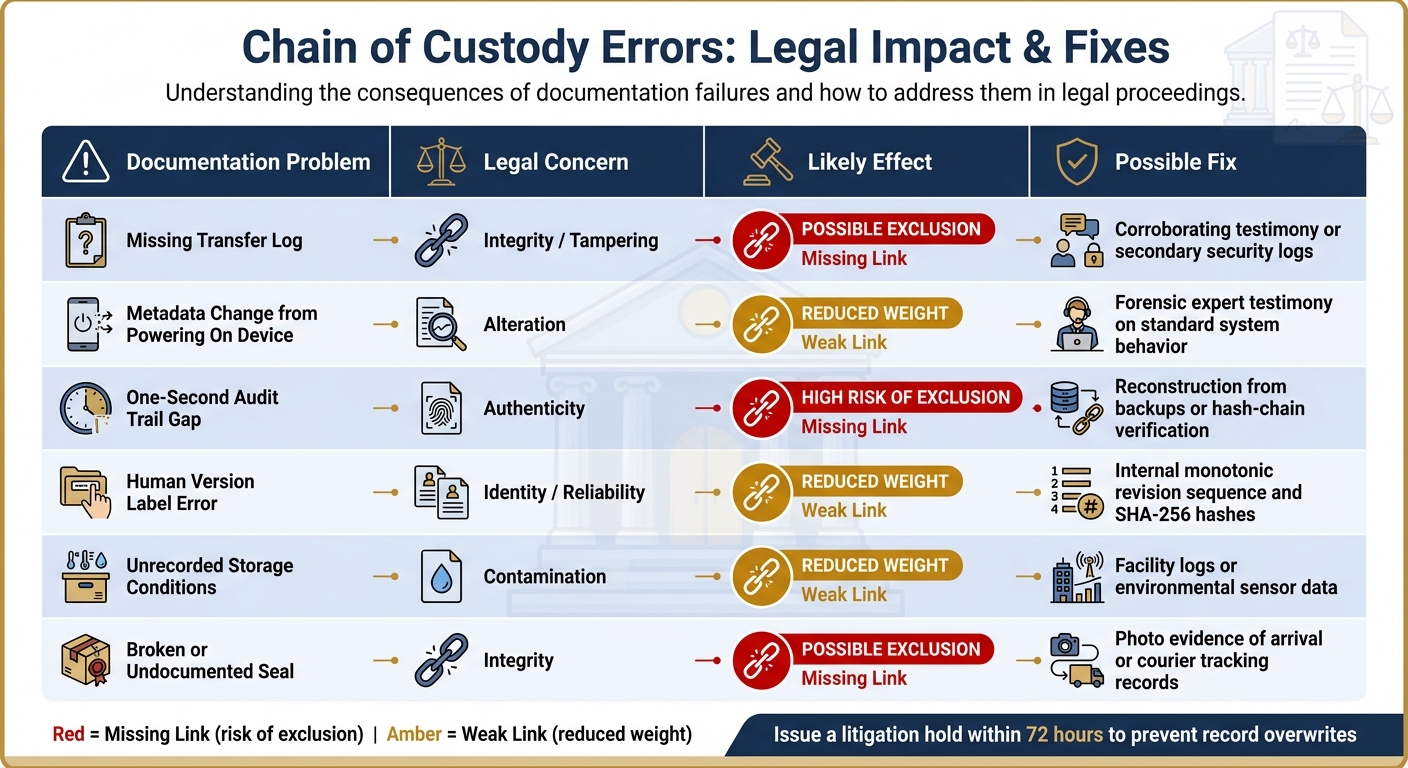
Chain of Custody Errors: Legal Impact & Fixes
When custody records have gaps, the fight often stops being about what happened and starts being about whether the evidence can be trusted. And that changes everything. In court, the key issue is whether the problem is a weak link or a missing link. A weak link is a smaller defect that creates doubt. A missing link is an unexplained gap that can stop authentication altogether.
Common errors that raise authenticity challenges
Missing transfer logs can leave behind orphaned evidence - items that show up in the record with no documented path explaining how they got there. Inconsistent labels or serial numbers can spark disputes over identity. And when seals are broken or there’s no record of the seal condition, that opens the door to questions about integrity, especially with physical samples.
Storage conditions matter more than many people think. If no one logged the temperature, humidity, or access controls for a storage facility, opposing counsel can argue the evidence was degraded or accessed without permission. With digital evidence, even one basic mistake can cause trouble. If someone powers on a device without a write-blocker, file-access timestamps and metadata can change. That alone may be enough to challenge the forensic image. Each break gives the other side a simpler path to attack authenticity.
Admissibility vs. weight
Not every error kills evidence. Smaller inconsistencies, like timestamp changes caused by powering on a device, usually affect weight more than admissibility. In plain English, the evidence may still come in, but the judge or jury may trust it less.
Bigger, unexplained gaps are another story. A missing transfer log or an unrecorded stretch of time when a device left the forensic team’s custody can support a motion to exclude, depending on the court and the type of evidence involved.
Comparison table: weak links, missing links, and possible fixes
These defects usually fall into two legal buckets: problems that hurt credibility and problems that threaten admissibility.
| Documentation Problem | Legal Concern | Likely Effect on Admissibility / Weight | Possible Fix |
|---|---|---|---|
| Missing transfer log | Integrity / Tampering | Possible exclusion (missing link) | Corroborating testimony or secondary security logs |
| Metadata change from powering on device | Alteration | Reduced weight (weak link) | Forensic expert testimony on standard system behavior |
| One-second audit trail gap | Authenticity | High risk of exclusion | Reconstruction from backups or hash-chain verification |
| Human version label error | Identity / Reliability | Reduced weight (weak link) | Internal monotonic revision sequence and SHA-256 hashes |
| Unrecorded storage conditions | Contamination | Reduced weight (weak link) | Facility logs or environmental sensor data |
| Broken or undocumented seal | Integrity | Possible exclusion (missing link) | Photo evidence of arrival or courier tracking records |
Corrective proof like expert testimony, backup logs, and hash verification can sometimes save a weak link. But when the record has a true missing link, fixing it after the fact is much harder.
Where the chain commonly breaks
Evidence usually falls apart at a few familiar points. One weak step can become a missing step fast.
Collection, packaging, and transfer
The first stage is often where things go wrong. If someone handles the original device before imaging, that can change metadata and hurt admissibility. For key physical evidence, use tracked delivery with confirmed receipt. If that is not possible, it is often better to send the expert to the evidence instead.
Log every handoff right away. A late entry opens the door to doubt. Once the item leaves the scene, the next problem often shows up during storage or testing.
Storage, testing, and court presentation
After collection, the chain often breaks during storage or analysis. Unlogged access to storage areas, shared workstations, or personal devices used without controls can trigger authenticity disputes. A missing access log may look like a small paperwork problem, but in court it can turn into a fight over admissibility.
In nursing home cases and similar matters, facilities may overwrite electronic records or staffing logs within days of an incident if no litigation hold is in place. Issue a litigation hold within 72 hours to stop overwrites. During testing, document intake, the analyst’s identity, and the equipment used. Even if a gap does not affect the underlying evidence, it still gives opposing counsel an easier argument at trial.
Digital evidence needs added integrity records
Digital evidence needs its own proof trail. A basic label is not enough. The record has to show that the same file reached court unchanged. At collection, record the acquisition method, source identifier, tool and version, analyst, and hash. If the file changes later, the hash changes too, which can point to tampering.
Timing matters as well. In one documented case, a 12-hour synchronization gap in a discovery repository let a privileged email thread get produced before it was flagged, and the judge treated that as a waiver of attorney-client privilege.
How to fix and prevent chain-of-custody problems
Fix the record before the evidence is challenged.
Build one evidence record that ties every identifier together
Create one master evidence log that connects each item to its collection record, description, photos, labels, dates, times, handlers, locations, and SHA-256 hash value. The goal is simple: every identifier should point to the same item, with no loose ends.
Even a small mismatch in dates, names, or transfer details can open the door to an authenticity challenge. For digital items, the hash works like a fingerprint. If anything changes - even one bit - the difference becomes detectable.
Use supporting proof to explain gaps rather than ignore them
If the record has a gap, rebuild it from other custody records instead of leaving it unexplained.
An unexplained gap gives the other side something to attack. Custodian declarations, property-room logs, and access logs can supply what the main custody log missed. If you need to fix the record, add a dated correction entry and leave the original in place. Don’t overwrite it.
Immutable log systems help here because they block silent edits by design. That keeps the audit trail intact and shows what changed, when it changed, and who made the correction.
Set written handling procedures before evidence moves
The best defense is a written protocol that governs each handoff before collection begins.
That protocol should spell out how evidence is sealed, who may transfer it, what storage conditions apply, and how digital files are preserved. Think of it as a set of binding rules, not a loose reminder sheet. It also helps to route forensic experts through counsel so communications stay controlled and documented.
Conclusion: How counsel should assess custody issues before court
Once you've found where custody records may fall apart, the next step is simple: pressure-test the record before you rely on it in court.
Chain of custody is the record counsel uses to check whether evidence is authentic, unchanged, and admissible. Even one undocumented transfer or missing gap in the record can weaken the case and open the door to exclusion.
4 questions to review before relying on evidence
Before using the evidence, review these four points:
- Can the item be uniquely identified by a hash, UUID, or similar identifier?
- Is every handoff, storage period, and transfer documented?
- Do logs and imaging records show a consistent handling history?
- Does any defect affect admissibility, or only weight?
Why early legal review can lower case risk
Early review can cut the risk of surprise exclusion, wasted discovery, and avoidable trial fights. It gives counsel time to spot custody defects before trial, shape discovery, and challenge weak evidence before it reaches the jury.
For individuals and businesses facing litigation, Million Dollar Case (https://milliondollarcase.com) can help connect you with counsel and help you look into legal-funding prequalification options.
FAQs
What counts as a broken chain of custody?
A chain of custody is considered broken when there’s any gap, missing handoff, or unexplained stretch of time in the record showing who handled, stored, or examined evidence.
That can happen in a few common ways:
- A transfer isn’t logged right away
- Evidence is left unsecured
- Someone takes unauthorized actions on files
Even a short gap in the audit trail, or a missed hash check, can trigger claims of tampering and lead to evidence being ruled inadmissible.
Can evidence still be used if the paperwork has mistakes?
Maybe. But mistakes or gaps in chain of custody paperwork can put evidence at serious risk of being ruled inadmissible.
The reason is simple: the chain of custody helps show that the evidence wasn't tampered with, altered, or mishandled. If even one transfer goes unlogged, or the audit trail has a gap, the other side can question whether the evidence is what it claims to be. And if that point can't be proven, the court may exclude the evidence.
How do you prove a digital file was not altered?
Prove a digital file was not altered by checking its hash value and keeping a documented chain of custody. A hash works like a digital fingerprint: if even one bit changes, the hash changes too.
In practice, professionals also use write-blockers during collection and keep immutable audit logs for every access or transfer. Put together, those records help show that the file presented is identical to the original.