My starting point for client retention: set clear service promises, then track whether you keep them. Review service gaps every 3 months, assign each fix an owner, and set a response target your team can meet - for example, returning routine messages within 48 hours.
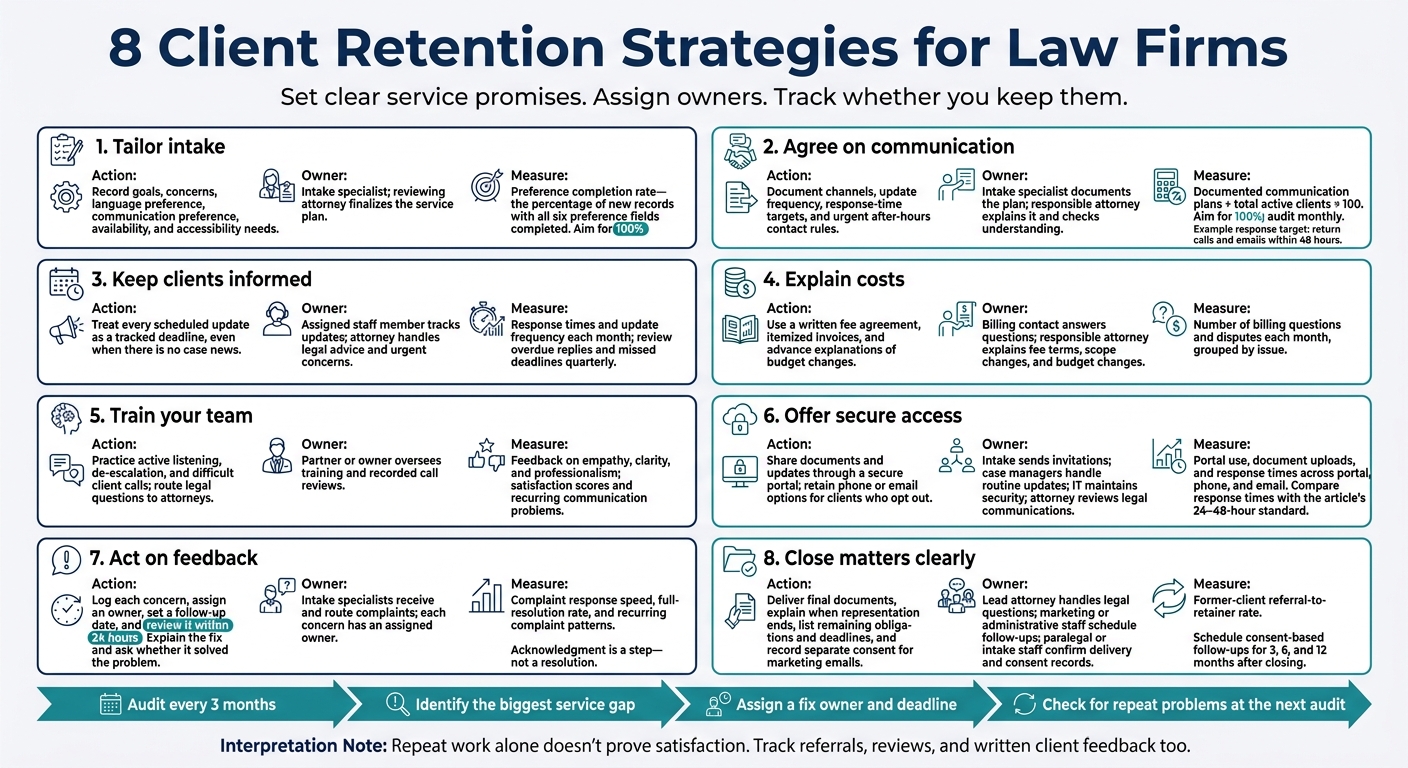
I’d focus on these eight habits:
- Tailor intake: Record each client’s goals, concerns, and contact needs.
- Agree on communication: Put channels, update schedules, and urgent-contact instructions in writing.
- Keep clients informed: Track updates and replies, even when there’s no case news.
- Explain costs: Make fees, expenses, and billing changes clear.
- Train your team: Practice listening, difficult calls, and routing legal questions to attorneys.
- Offer secure access: Share documents and updates through a portal, with other contact options.
- Act on feedback: Assign complaints an owner and follow through until the issue is resolved.
- Close matters clearly: Explain what’s finished, note remaining deadlines, and get consent for marketing follow-ups.
I’d aim for 100% of active clients to have a written communication plan, then review response times, billing questions, and client feedback together. <u>Repeat work alone doesn’t prove satisfaction</u> - especially when clients only need a lawyer once. Track referrals and reviews too, and use what clients tell you to choose the next service gap to fix.
8 Client Retention Strategies for Law Firms
Why Clients Leave Your Law Firm (It's Not What You Think)
sbb-itb-22d0d6e
Review Current Client Service
Client retention starts with finding where service falls short. Audit the client experience every three months. Check intake records, communication logs, and client feedback for recurring issues, such as unanswered inquiries or delayed transfers. These gaps can chip away at trust.
Trace each issue to its source. Call logs can reveal unnecessary transfers, while intake recordings show whether staff listen with empathy and gather the details they need.
Put one person in charge of the review. A single owner helps keep reviews consistent and fixes on track. Monitor response times, assign someone to each fix, and check for repeat problems at the next audit. Address the biggest service failures first.
Set clear standards that your team can meet and clients can understand. Is your response-time target realistic, and does your team meet it consistently? Personal injury intake may also call for triage that pairs empathy with careful fact-finding. Shape your standards around client needs, urgent matters, and state conduct rules.
1. Tailor Intake and Service to Each Client
Implementation steps
Use your service audit to identify each client’s needs during intake. Include fields for goals, concerns, language preference, communication preference, availability, and accessibility needs. Save these details in the case record so every team member can follow the same service plan and tailor service from day one.
Client relationship benefit
Personalized intake builds trust and reduces friction at the start of the relationship.
Owner
Make an intake specialist the primary contact. The reviewing attorney finalizes the service plan.
Metric
Track preference completion rate: the percentage of new records with all six preference fields completed. Aim for 100%.
2. Agree on Communication Expectations
Implementation steps
Use the intake details to agree on how and when you’ll communicate before work starts. Put preferred channels, update frequency, response-time targets, and rules for urgent after-hours contact in one written communication plan.
Set a response target, such as returning calls and emails within 48 hours.
Explain the plan in plain English, and give the client their next contact date before intake ends.
Client relationship benefit
Clear expectations help build trust. When clients know when they’ll hear from you, they’re less likely to mistake routine silence for neglect.
Responsible team member
The intake specialist documents the plan. The responsible attorney explains it and checks that the client understands. Update the plan when the matter enters litigation or settlement, or when contact needs change.
Service performance measure
Audit plans monthly: documented communication plans ÷ total active clients × 100. Aim for 100%, and flag missing plans for completion. This baseline helps the team deliver consistent updates.
3. Give Regular Updates and Prompt Responses
Implementation steps
Once the communication plan is set, treat every scheduled update as a tracked deadline. Cover case progress, deadlines, client decisions, and next steps. If nothing has changed, explain what you’re waiting for and when you’ll check in again.
Set automated reminders for updates, appointments, and document requests.
Client relationship benefit
An update during a quiet period shows clients that their matter is still active. It also helps ease anxiety when progress slows.
Responsible team member
Assign a staff member to track updates and flag unanswered messages. The attorney should handle legal advice and urgent concerns. Keep messages and follow-up tasks in one shared case-management system or client portal so the team can track responses.
Service performance measure
Track response times and how often updates go out each month. Review missed deadlines and overdue replies quarterly.
4. Explain Fees and Send Clear Bills
Implementation steps
Apply the communication standards you’ve already set to billing, too. Clients shouldn’t have to guess what your work costs.
Use a written fee agreement that covers scope, rates, retainers, expenses, and billing intervals. Send itemized invoices, and explain budget changes before clients face unexpected costs.
Match the fee model to the matter: hourly billing for open-ended work, flat fees for defined tasks, contingency fees when permitted, and custom terms for hybrid matters.
Contingency fees are barred in criminal defense and certain domestic relations matters, so check the applicable state rules. State whether clients owe expenses even if there’s no recovery.
Client relationship benefit
Clear billing reduces disputes and builds trust.
Responsible team member
Assign a billing contact, such as the office manager or billing coordinator, to answer questions. The responsible attorney should explain fee terms, scope changes, and budget changes.
Service performance measure
Track the number of billing questions and disputes each month. Group questions by unclear charges, expenses, retainer balances, or scope changes. If the same questions keep coming up, clarify your invoices or revise your fee explanation.
5. Train Staff to Listen and Respond Professionally
Implementation steps
Clients judge service in every conversation - not just through the legal work. Use role-play and coaching to help staff practice active listening, de-escalation, and difficult client calls.
Give staff response scripts that keep conversations professional and within ethical boundaries. Staff should gather facts, explain the next step, and direct legal questions to the attorney. If a concern exceeds staff authority or the client relationship is deteriorating, document it and pass it to the attorney. A consistent approach helps keep routine conversations from becoming service complaints.
Client relationship benefit
Clients who feel heard are more likely to trust the team.
Responsible team member
A partner or owner should oversee training and reinforce it through recorded call reviews.
Service performance measure
Track client feedback on empathy, clarity, and professionalism, along with satisfaction scores. Use that feedback during coaching, and track recurring communication problems through call reviews.
6. Give Clients Secure Access to Case Information
Implementation steps
Once communication expectations are set, give clients a secure way to follow their matter without extra calls. Use a secure client portal for case updates and document exchange. Preload intake details so clients don’t have to enter them again.
Set access permissions to protect confidential records, and separate internal material from client-facing updates. Have the responsible attorney handle or review critical legal communications before sharing them. Follow the communication plan’s update schedule and recorded channel preferences. Provide phone or email updates for clients who opt out of the portal.
Client relationship benefit
Access should make updates easier, not add extra steps. Letting clients check case information themselves can reduce status requests when the portal meets their channel preferences and accessibility needs.
Responsible team member
Intake specialists send portal invitations, case managers handle routine updates, IT maintains security, and the responsible attorney reviews legal communications.
Service performance measure
Track portal use, document uploads, and response times across the portal, phone, and email. Compare response times with the 24–48-hour standard.
7. Ask for Feedback and Resolve Service Problems
Even strong communication systems can miss problems. Give clients a simple way to flag them.
Implementation steps
Routine updates don’t tell you everything about a client’s experience. Send a brief follow-up email after resolution, and check satisfaction periodically during active matters to spot problems early.
Log each concern, assign an owner, set a follow-up date, and review it within 24 hours. If the fix needs more time, explain the next step and when the client can expect an update. Once you’ve acted, explain what changed and ask whether it solved the problem.
Client relationship benefit
Asking for feedback only works if the firm acts on it. Fast follow-through helps protect the client relationship. If a client posts negative feedback online, respond professionally, then move the conversation offline to address the issue.
Complaints need to reach the right person promptly for this process to work.
Responsible team member
Intake specialists should receive complaints first and route them to the right person. Review recurring issues monthly and audit intake every 3 months to find service gaps.
Service performance measure
Track complaint response speed, full-resolution rate, and recurring complaint patterns. Use closed-loop reporting and tagging to get complaint feedback to the right team. Acknowledgment is a step - not a resolution.
8. Close Matters Clearly and Schedule Follow-Ups
Implementation steps
Keep communication clear through the final handoff. Send final documents through the portal, state when representation ends, and list any remaining obligations and deadlines. Schedule one last check-in before closing the matter.
Get separate consent for marketing emails, then record the client’s consent and preferred contact channel in the CRM. Add clients who opt in to a former-client follow-up workflow.
A clear close reduces confusion and helps preserve the relationship for future work.
Client relationship benefit
A clear handoff shows clients what’s finished and what still needs attention. It also keeps future contact permission-based, without implying that the firm is still working on the matter.
Responsible team member
The lead attorney should answer post-close legal questions and remain the main client contact. Marketing or administrative staff schedule the CRM workflow, while a paralegal or intake team member confirms document delivery and consent records.
Service performance measure
Track the former-client referral-to-retainer rate to see whether closing follow-ups lead to future matters.
Client Retention Action Checklist
Use this checklist to turn the service standards above into assigned tasks. Give every action an owner and a target date, and record both in the CRM.
- Intake and contacts: Confirm that a dedicated intake contact and reviewing attorney are assigned. Set targets for same-day inquiry responses and attorney review within 24 hours. Check that the file records the client’s case type, goals, and contact preferences.
- Communication and billing: Check that agreed update schedules, response standards, scope, and initial budgets are documented and followed. Review monthly invoices to make sure entries describe the work performed.
- Staff and secure access: Confirm that weekly coaching covers intake calls, scripts, and active listening. Check that the secure portal supports document uploads and delivery of key case documents.
- Feedback and follow-through: Check that complaints have assigned owners and due dates, closing tasks are completed and logged, and consent-based follow-ups are scheduled for 3, 6, and 12 months after closing.
Keep these completion records as the baseline for tracking service performance.
Measure Client Service and Retention
Use the service standards above to check whether retention is improving. Define who you're measuring before calculating rates. Count raw leads, qualified leads, and clients separately. Set one measurement period with clear rules for who qualifies and who is excluded.
Measure repeat engagements separately. Track the percentage of clients whose matters closed during a defined period who return with a new matter. For one-time matters, track referrals and reviews instead.
Measure the share of calls and emails answered within your policy window. Check whether automated updates and portals keep clients informed at each milestone.
Collect satisfaction feedback during the matter and after closing. Include one written question asking what needs improvement. Review comments about response speed, updates, portal use, billing clarity, and follow-through. Use Net Promoter Score (NPS) only as a secondary signal of referral intent.
Read the numbers together, not in isolation. Compare results by practice area, client type, and team, and read written feedback alongside the numbers. Repeat business and referrals can signal trust, but they don't prove satisfaction. Compare intake speed and lead quality with retention outcomes. Use the checklist below to assign owners and targets for these measures.
Conclusion: Make Client Service Consistent
Clients build trust in your firm when service stays consistent - from intake and updates to billing, staff interactions, and follow-up.
Fix the biggest service gap first. Put one person in charge and give them authority to coordinate the fixes. Focus on promises your firm can keep, set a deadline, and review progress quarterly.
FAQs
How can a small law firm improve retention on a tight budget?
Build client relationships through simple, low-cost communication. Return calls within 24 hours, reply to emails promptly, and share regular status updates along with copies of important documents.
Include clients in planning and decision-making so they feel like partners. A thank-you note or card for their business or referrals adds a personal touch and helps build loyalty.
How can we rebuild trust after a service failure?
Address the issue promptly and openly. If you suspect a mistake, contact your malpractice provider first for guidance on how to communicate with the client.
Respond to negative feedback calmly and professionally. Acknowledge the client’s concerns, then move the conversation offline. Take ownership, listen to their perspective, and work toward a path forward. Keep communication honest and consistent to help repair the relationship and show your commitment to quality service.
How can we request client reviews without risking confidentiality?
Follow your state bar’s ethics rules on solicitation, and ask for reviews only after a case is successfully resolved. Never offer incentives for positive feedback.
Create a consistent process for inviting satisfied clients to share their experiences. Provide a direct, neutral link to your Google Business Profile. Keep your responses professional and focused on the client, and don’t disclose sensitive case details.