I start with one goal for each witness, then write short, leading questions that address one fact at a time. My rule: support each question with the record, listen to the answer, and stop when I get the admission I need.
Here’s my checklist:
- Plan the sequence: Identify key admissions, link questions to documents or testimony, and mark the five questions that matter most.
- Test the account: Examine what the witness saw, remembers, said before, and may have at stake.
- Check expert opinions: Question the facts, assumptions, and methods behind each conclusion.
- Follow court limits: Check Rule 611, applicable state rules, and court orders. Pause for objections and follow the ruling.
- Prepare with counsel: Review exhibits, likely answers, follow-ups, and topics to avoid.
The point isn’t to win an argument. I aim to build <u>a clear record, one answer at a time</u>.
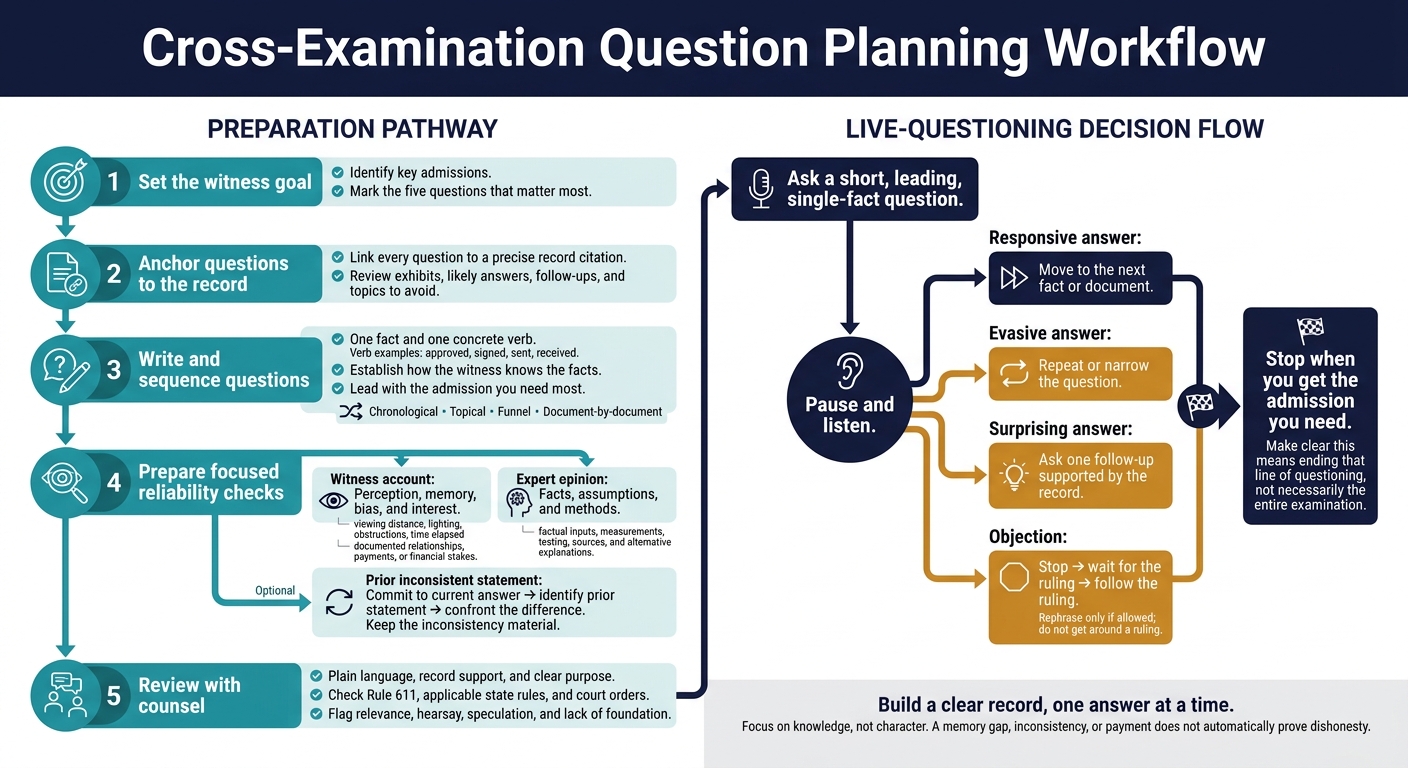
Cross-Examination Question Planning Workflow
Write Short Questions and Order Admissions
Ask About One Fact at a Time
Keep each question to one fact and one concrete verb: approved, signed, sent, received. Name the document instead of saying “it” or “that paperwork.” Break up double negatives and compound questions.
Hypothetical business dispute - not an actual case: “You approved invoice 1042, correct?” Then: “That invoice listed $8,500, correct?” Ask each separately, and only if the record supports the premise.
| Question type | Purpose | Control level | Principal risk | Appropriate courtroom use |
|---|---|---|---|---|
| Leading | Guide the witness to a specific fact | High | Objection during direct examination | Cross-examination; foundation questions |
| Open-ended | Invite a narrative | Low | Rambling; unpredictable answers | Direct examination |
| Compound | Combine multiple facts | Low | Confusion; compound-question objection | Avoid; ask separate questions |
| Argumentative | Press the witness rather than seek a fact | Low | Loss of jury empathy; objection | Avoid; focus on facts |
| Speculative | Ask for guesses or opinions | Low | Inadmissible testimony | Avoid; stick to the witness’s perception or knowledge |
Sequence Admissions Step by Step
Arrange single-fact questions so each answer supports the next. Before reaching the disputed point, establish how the witness knows the facts.
Group questions around a narrow subject, and add a brief transition when switching topics. Lead with the admission you need most. Once a group of questions gets that admission, move on.
| Sequence | Practical use | Control benefit | Risk |
|---|---|---|---|
| Chronological | Build a timeline of events | Easy for the jury to follow | Predictable for the witness |
| Topical | Group admissions by subject | Keeps questions focused on specific goals | Can feel disjointed without transitions |
| Funnel | Move from broad facts to narrow facts | Forces a narrow answer | Witness may anticipate the next question |
| Document-by-document | Confront the witness with evidence | Very high control | Can be slow and tedious for the jury |
Respond to Evasive Answers and Objections
Pause and listen. If the witness doesn't answer, repeat or narrow the question. If an answer surprises you, ask one follow-up supported by the record. Don't argue or repeat the answer you expected.
Stop when someone objects and wait for the ruling. Follow the judge’s ruling. If the judge allows you to rephrase, remove argumentative wording, establish any assumed fact, split compound questions, or limit the question to what the witness knows.
If the court limits the question, address the ruling to the court - not the witness. Don't use rephrasing to get around a ruling.
When the witness answers within the scope of the question, move to the next fact or document.
sbb-itb-22d0d6e
Question Witness Reliability and Expert Opinions
Test Perception, Memory, Bias, and Interest
Once you establish the fact, test whether the witness could actually know it. Focus on the limits of their knowledge - not their character. Use records to establish viewing distance, lighting, obstructions, time elapsed, and what the witness personally observed. Keep the questions tied to conditions that affected their ability to perceive what happened.
Distinguish a failure to remember from a conflicting account. Neither automatically proves dishonesty. To examine bias, establish documented relationships, payments, or financial stakes. Any question about prior conduct must have a factual basis under the applicable evidence rules.
Use Prior Statements and Conflicting Evidence
Commit the witness to the current answer before presenting the prior statement and pointing out the difference. Medical records, deposition transcripts, reports, and other records can reveal conflicts. If the witness cannot remember, let “I do not recall” stand rather than pushing for a guess. Focus on material inconsistencies, not side issues.
Apply the same discipline to each reliability problem: one issue, one sequence, one goal.
| Impeachment method | Target | Required foundation | Question sequence | Principal limitation |
|---|---|---|---|---|
| Prior inconsistent statement | Changed account | Earlier documented statement and a real inconsistency | Commit to current answer → identify prior statement → confront the difference | Keep the inconsistency material |
| Bias or interest | Possible motive | Relationship, payment, or financial stake | Establish connection → examine interest | A payment alone does not prove dishonesty |
| Independent contradiction | Accuracy of a fact | Admissible conflicting evidence | Identify testimony → establish conflicting fact | Tie the contradiction to a material fact |
| Defective perception | Opportunity to observe | Viewing conditions and time elapsed | Establish conditions → highlight gaps | Stay within what the witness could reasonably observe |
| Flawed expert methodology | Reliability of opinion | Methods, inputs, and omissions | Establish method → test application | Rule 702 addresses admissibility; cross-examination often addresses weight |
Test Expert Assumptions and Methods
With expert witnesses, move from the opinion to the assumptions behind it. Limit qualification questions to credentials that support the opinion. Then examine the expert’s factual inputs, measurements, testing, sources, and alternative explanations.
Ask exactly which records the expert reviewed, which physicians they consulted, and which literature they relied on. Test whether the assumptions, inputs, and method are consistent, keeping each line of questioning focused on one issue and one goal.
If you use a learned treatise, first establish the publication as a reliable authority. Relevant statements may be read into evidence, but the publication itself is not admitted as an exhibit. Rule 702 addresses admissibility; cross-examination of an admitted opinion often addresses the weight it deserves.
Prepare and Review Each Witness Examination
Build a Witness Plan and Evidence File
Once you’ve set the question sequence, turn it into a witness-specific trial plan.
Cover the witness’s background, bias, prior testimony, examination goal, key admissions, likely answers, evasions, follow-ups, and topics to avoid. Link every question to a precise record citation. Use a subject outline rather than a script.
Review exhibits with the witness so they understand why each document matters. Have clients organize records and flag discrepancies, but leave authentication, hearsay, and foundation decisions to counsel. Use mock examinations or role-playing to spot inconsistencies and prepare follow-up questions. Practice active listening, too, so the witness focuses on each question.
If the record includes video depositions, review them for mannerisms, tics, and clips that could hurt the witness’s testimony at trial.
Then use the plan to test each question against the record before trial.
Check Questions and Review the Plan With Counsel
Before finalizing the outline, check that every question uses plain language, has support in the record, and serves a clear purpose. Flag likely objections, including relevance, hearsay, speculation, and lack of foundation. Keep questions closed.
Mark the five questions that must be answered to meet the examination goal. Keep them in the plan even if the testimony shifts.
Conclusion: Keep Questions Focused and Supported
Work with counsel to close preparation gaps and protect the admission sequence if testimony changes unexpectedly.
Podcast - Cross-Examination: Asking the Right Leading Questions
FAQs
Can I cross-examine a witness about new topics?
It depends on the permitted scope of questioning. New topics often fall outside that scope because cross-examination typically focuses on clarifying, explaining, or adding context to evidence already introduced.
Check your local court rules. Courts strictly enforce limits on the scope of testimony to keep the trial structured.
What if a witness denies their prior statement?
Denying an earlier statement or facing conflicting information during cross-examination can make a witness seem less believable - or even dishonest. Witnesses should be coached to answer based only on what they currently remember, know, or feel, without making absolute claims that later facts could disprove.
If new information comes to light, witnesses can acknowledge it honestly and explain that their earlier answers reflected what they knew at the time.
When should I skip cross-examination?
Skip cross-examination if you’re not prepared or don’t have a clear plan and purpose. Going in unprepared can cost you chances to challenge a witness. You also risk losing momentum or the jury’s trust.
Keep your questions simple and grounded in common sense. Debating fine technical details with an expert witness can confuse jurors and make the expert seem more knowledgeable than you.